Thursday, March 30, 2017

My Activities for the past few years.

It is National Crochet Month (NatCroMo) and it seemed appropriate to create a blog post to celebrate the month and to let folks know what I have been up to for the past few years, and where I stand on future plans.

I haven't done anything for profit over the past few years.  It has been a bittersweet time, having lost an Aunt in summer 2015, having lost my father in November 2015 (Although it was wonderful to spend a little time with family at my father's funeral.).  My son, Paul, is still living off of freelance artwork in Europe and I have reached the age my mother was when she passed away.  I also lost my dear friend and a mentor, Susan Huxley, to cancer in 2016. On top of that, I started 2015 with no voice after my thyroidectomy; my vocal cords apparently had been stretched during surgery and refused to work for 3 months.    With all that going on I lost my initiative to do work.  Instead I mostly did self-indulgent art works.

Here are my earlier creations.  The first is my Heritage Heart which I created in 2013 for Prudence Mapstone's Hearts & Flowers freeform knit and crochet show.  Although well before 2015, I am showing it because it is the most meaningful piece I have ever made.  Its base is a heart, reminiscent of those I saw during my high school years in Germany.  The flowers are all symbolic of my heritage, a wild rose for England, an iris for France, a cornflower and an edelweiss for Germany, a double rose for New York, a violet for Wisconsin, and a dogwood flower for Virginia.


My 2015 "Tribute to Peter Max" contribution to Prudence Mapstone's 50 Years of Flower Power collaborative art piece made the cover of Down Under Textiles in 2015.


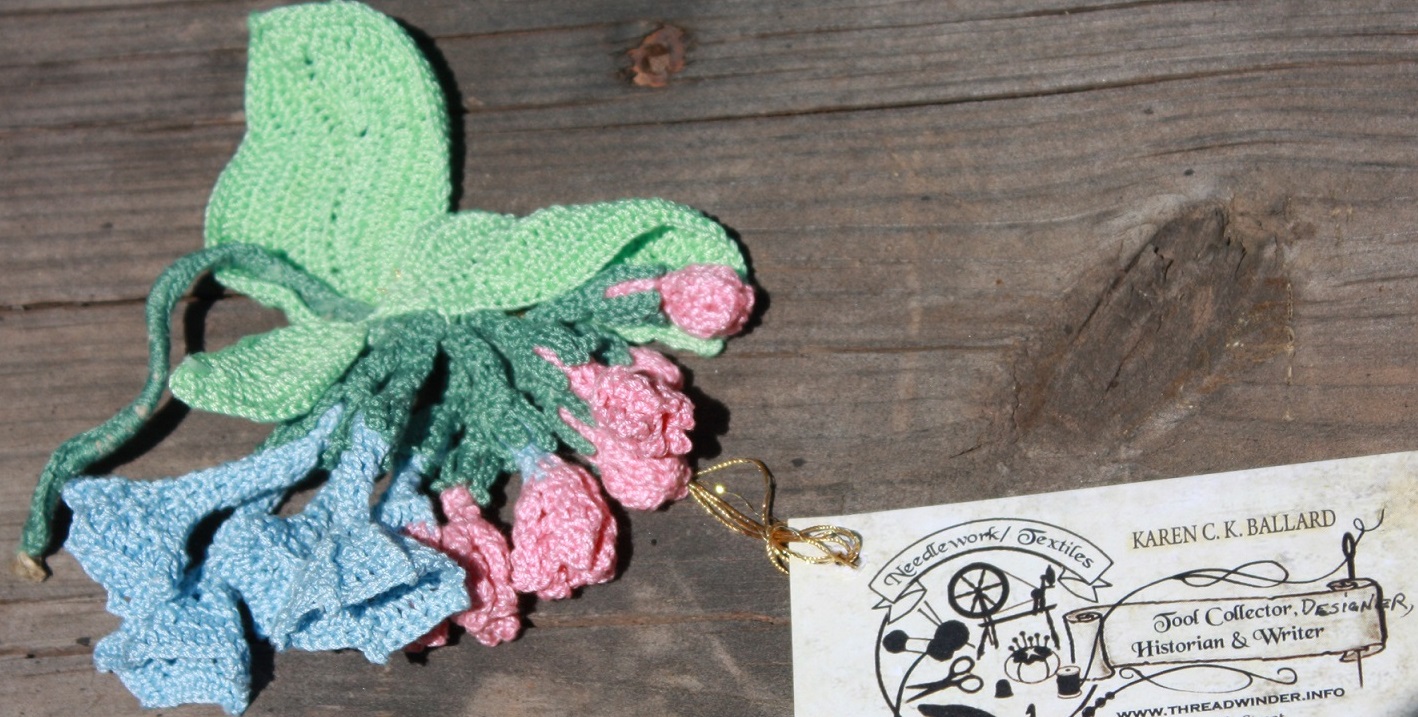
In 2015 I made this contribution for an English project called Flowers for the Memories (Alzheimer's research) project.  I wanted to provide something related to Virginia, so I made Virginia bluebells.

My 2015 contributions Kathryn Vercillo's Tribute to Wink (depression awareness).  I used elements of Wink's designs to create my own mandalas.


n 2016, I contributed a crocheted stream, including waterfall to the UK University of Sheffield's Crocheted Hyperbolic Forest:


I made a hearts and Irish rose square to Kyle Kunnecke's blanket for his sick mom:


Prudence Mapstone wanted me to contribute to her Jumpers & Jazz yarn-bombing of Australian trees.  I was running out of time and didn't know what to create, but I started out with the bullioned round.  Later, when the squirrels, were scolding me for coming out of my back door--for disturbing them in their maple tree, I decided the bullioned round would make a great squirrel thigh.  Here my squirrel contribution is sitting on top of many other lovely freeform contributions in an Australian palm tree.


I made this Sonoran Sunset (named after the stone cabochon) necklace for myself, although I have not added a clasp yet.


I also gave talks to the Prince William Purlers and to the Prince William Crochet Guild on yarn winders and on the World War I Knitting Campaign.   
This year I have written my first quarterly article for the Crochet Guild of America (CGOA) Chain Link Newsletter  and I researched and wrote the Feb 16th blog entry in an effort to confirm the tomato/strawberry pincushion story (see that blog entry).  I have participated in Crochetville's NatCroMo, donating 6 lots of vintage crochet books.  It was much easier this year, with Amy Shelton and Donna Hulka organizing all the giveaways.  I have done research and organization of information for the book I am writing and I have made much progress at releasing my Inner Beast.  I have visited Bayfront Park, in Chesapeake, MD, twice, in search of fossils, sea glass, and "mystery beads".  I plan to go on future visits, in search of sufficient numbers of beads to make a mystery-bead jewelry piece.  I also need to ratchet up my organizing of the collaborative art piece that I plan to sponsor: a Freeform Textile Tribute to the Arts.
    
Back on 4 January I made a prioritized goal list.  I will update that post no later than tomorrow evening.

Thursday, February 16, 2017

Publications Containing Pincushions, looking to confirm tomato/strawberry story

On FaceBook I found a story about tomatoes being put on mantels to bring prosperity, with perishable tomatoes eventually being replaced by tomato pincushions with attached strawberry emeries.  Kathryn Newell rightfully questioned the story and sent me on a quest to confirm or refute it.  I consulted following publications on needlework tools..

Although these pincushions were very common, I found relatively few examples of tomato/strawberry pincushions/emeries; I suspect the books focused on the more unusual/desirable.  I have included references to pinballs, because tomatoes may have been derived from them (as indicated by Zann Carter’s Shaker derivation story), and I included references to Shaker, Amish, and Mennonite pincushions, in case they originated tomato pincushions.  Zann also contributed information about a superstition of tomatoes being put on the hearth for prosperity, a story suspiciously similar to tomatoes being put on the mantel for prosperity.

Knowing it is nearly impossible to disprove a negative, I was really looking for confirmation.  Despite some of the publications telling origin stories, none repeated the questionable story.  However, there is ample evidence that tomato and strawberry pincushions and emeries originated in the Victorian era (1849-1901), and that tomato pincushions evolved from earlier pinballs with the Victorian penchant for making pincushions look like fruits, vegetables, and numerous other novelty shapes. 

---. Authentic Victoria Pincushions  Originally Published 1896! Set #1 (2007) Dakota Prairie Treasures; Instructions for making many late 19th century pincushions but no tomatoes or strawberries.
---. Authentic Victoria Pincushions  Originally Published 1898! Set #2 (2007) Dakota Prairie Treasures; depicts a pincushion with two tomatoes on one stem.
---. Authentic Victoria Pincushions  Originally Published 1901! Set #4 (2007) Dakota Prairie Treasures; Instructions for making many late 19th century pincushions but no tomatoes or strawberries.
---. Bonhams The Sewing Sale catalog (Dec 2001) Bonhams, London, UK; many high-end needlework tools including pincushions, but no tomatoes/strawberries.
---. Christie's Thimbles & Sewing Accessories catalog (Jun 2000) Christie's, London, UK; only cover pictures, only descriptions of seemingly exquisite needlework tools including pincushions, but no tomatoes or strawberries.
---. Phillips Textiles catalog (Sep 1999) Phillips, London, UK; textiles/laces, needlework tools, & clothing/accessories, but no pincushions.
---. Weldon's Practical Pincushions (Originally published ~1894 by Weldons Pub Co, London; 2009) Iva Rose Vintage Reproductions, New Bedford, MA; (Set #3, subtitled: Originally Published c1900!; 2006); republication by Dakota Prairie Treasures; Instructions for making many late 19th century pincushions but no tomatoes or strawberries.
Andere, Mary.  Old Needlework Boxes & Tools Their Story and How to Collect Them (1971) Drake Publishers Ltd., NY; “Pinballs dated from the 1720 onwards were popular to mid-nineteenth century.  The Victorian era was, perhaps the heyday of the pincushion.  They were made in every conceivable shape.  Fruits were much in vogue, strawberries in particular, since their pitted surface lent itself to reproductions by the use of pinheads studded into red velvet or silk.”  No tomato pincushions mentioned.
Barker, Harold (compiler). A Pictorial Survey of Mostly American Sewing Tools & Supplies (1835-1950) Volume I (1835-1908) (1998) Harold Barker, Ada, OH; This book is a compilation of numerous advertisements and articles organized only by date.  Two strawberry emeries dated 1893 & 1894 depicted.
Bowles, Ella Shannon. Homespun Handicrafts (1931) J.B. Lippincott Co., Philadelphia & London; with chapters on spinning, weaving, knitting, embroidery, quilts, rug-making Netting, &amp lace, includes tools; but no pincushions.
Burgess, Fred. W. Chats on Household Curios (c1914); Frederick A. Stokes Co., NY;  pp 223-250 chapter: "The Old Workbox" includes spinning wheels and numerous "Little Accessories" for lace-making, cutting, knitting, pins, & pincushions, but no tomato/strawberry pincushions/emeries.
Burn, Diane Pelham. Sew Precious & Children's Needlework Tools &amp Dolls' Sewing Tools (2010) Diane Pelham Burn, UK; Children's & dolls' needlework tools of all sorts; depicts a couple tomato pincushions & several strawberry emeries, but not mentioned in text.
Burn, Diane Pelham. Sew Small & Children's Needlework Tools (1995-Thimble Collectors Intn'l, 2010) Mintsalad Design, UK; Children's needlework tools of all sorts, however pincushions are barely mentioned and no tomato/strawberry pincushions/emeries mentioned.
Clement, Joyce.  Official Price Guide to Sewing Collectibles (1987) House of Collectables, NY; all types of needlework tools, including small chapters on crochet tools, threads, & thread holders; pincushions are barely mentioned, however no tomato/strawberry pincushions/emeries mentioned.
Colby, Averil. Pincushions (1975) B.T.Batsford Ltd., London & Sydney; no tomato/strawberry pincushions/emeries mentioned.
Franklin, Linda Campbell. 300 Years of Housekeeping Collectibles (1992) Books Americana, Florence, AL; includes sewing/mending tools, auto knitter, &amp laundering tools; but no pincushions.
Gaussen, Elaine.  Miller’s Sewing Accessories & A Collector’s Guide (2001) Octopus Pub. Group, Ltd., London; sewing accessories of all types, including a small number of crochet hooks, spool knaves and pincushions, but no tomato/strawberry pincushions/emeries mentioned.
Gengelbach, Darlene J. Encyclopedia of Children's Sewing Collectibles Identification & Values Sewing Sets Dolls Books Patterns (2007) Collector Books, Paducah, KY; mostly sewing, but also knitting, crochet, weaving, books & patterns; depicts “a small hinged sewing stand, like many used in the 1930s” with tomato pincushion; and a “1957 Junior Miss Embroidery Case” with mini tomato/strawberry pincushion & emery.
Gower, Jolynn (Acquisitions Editor). Notions & Over 50 Great Gadgets You Can't Live Without (2000) Taunton Press, Inc, Newtown, CT; no tomato/strawberry pincushions/emeries mentioned.
Groves, Sylvia.  The History of Needlework Tools &amp Accessories 2nd impr. (1968) Country Life Books, Feltham, Middlesex, UK; all types of needlework including tambour, crochet & knitting tools; regarding pincushions/emeries: “Nothing was too fanciful for these engaging trifles…” “The Victorian age abounded with pincushions.” Two tomato-style pincushions are depicted.
Gullers, Barbara D.  Antique Sewing Tools & Tales (1992) Gullers Pictorial Partnership, Phoenix, AZ; stories about textile tools and beautiful photos of exquisite needlework tools including a small selection of crochet & tambour hooks and yarn & thread holders but no tomato/strawberry pincushions or emeries.
Houart, Victor. Sewing Accessories & An Illustrated History (1984) Souvenir Press Ltd., London; Miscellaneous tools including pincushions and emeries: “Most of the fanciful pincushion containers were made in the shape of fruit (mainly strawberries), flowers, … “  “[emery cushions] went out of fashion in the early 1920s when needles and pins were made in stainless steel.”  [Although I bought at least one tomato pincushion with attached strawberry in the early 1960s.—Karen Ballard]
Jeffords, Mignon S. Sharing Sewing Sets (1984) B.F. Long Printing Co., Spartanburg, SC; etuis, necessaires, chatelaines, etc.; two strawberry emeries, one on a chatelaine, pictured.
Johnson, Eleanor. Needlework & Embroidery Tools (1999) Shire Pubs Ltd., Princes Risborough, Buckinghamshire, UK; “Another type of cushion…is the emery cushion”… “One type often met is a small fabric or knitted strawberry decorated with small yellow beads to add realism.” Two tomato pincushions are pictured.
Johnson, Eleanor.  Needlework Tools Shire 38 (1978-83) Shire Pubs., Ltd., Aylesbury, Bucks, UK; includes numerous needlework tools, including a strawberry emery and a tomato-like pincushion; no text about them.
Longman, E.D. &amp Loch, S. Pins & Pincushions (1911) Longmans. Green & Co., London, NY, Bombay & Calcutta; about pins of all types including hairpins, pincushions, & related superstitions/customs/charms;  includes a large section on late eighteenth century pinballs, but no mention of tomato/strawberry pincushions/emeries in the 35 page chapter on pincushions.
McConnel, Bridget.  The Story of Antique Needlework Tools (1999) Shiffer Pub. Co., PA; all types of needlework tools including a small number of crochet/tambour hooks, thread holders, pincushions, & emeries.  “Pin-balls are a very typical eighteenth century item.” Pictured: two leather tomato-shaped pincushions & one strawberry emery.
Proctor, Molly.  Needlework Tools & Accessories & A Collector’s Guide (1990) B.T. Batsford, London; covers all types of needlework tools including pincushions:  “…there are so many variations [of pincushions] this [categorizing] is almost impossible.”  “From 1880-1910 pincushions were made into realistic shapes using patterns printed in journals.”  However no tomatoes or strawberries mentioned or depicted.
Rogers, Gay Ann. An Illustrated History of Needlework Tools (1983, 4th printing 1991) John Murray, London; includes sewing & threadwork tools including pincushions; “By the eighteenth century the small pincushion worn suspended from the waist had evolved into two major types associated with nineteenth century pincushions: the pinball and the disc.” … “In the nineteenth century needlewomen made pincushions in every shape from stars, flowers, vegetables, and animals of every type.” “Emeries usually came in small sizes, often in fanciful imitation of berries or of miniature fruit.”  Pictured: 2 tomato-style pincushions, a strawberry emery with silver cap, and a small tomato emery.
Rogers, Gay Ann. Price Guide to An Illustrated History of Needlework Tools (1989) Needlework Unlimited, Claremont, CA; includes prices for the pictured pincushions and emeries.
Sommer, Elyse.  Textile Collector’s Guide & Valuables… Usables… Reusables (1978) Monarch, NY; includes a small section on textile tools of all sorts including pincushions, but no tomato/strawberry pincushions/emeries.
Souder, Mattie. Notions (1922) The Ronald Press Co., NY; includes contemporary sewing tools & notions, but no pincushions or emeries.
Taunton, Nerylla.  Antique Needlework Tools & Embroideries (1997) Antiques Collectors’ Club Ltd., Woodbridge, Suffolk, UK; needlework tools, including some crochet/tambour hooks, thread holders, & pincushions; but no tomato/strawberry pincushions/emeries.
Thompson, Helen Lester Sewing Tools & Trinkets Vol 1 (1997) Collector Books, Paducah, KY; numerous needlework tools including pincushions.  Doesn’t have any text about tomato/strawberry pincushions or emeries, but depicts several of each from the 1900s-1930s, including 3 Mennonite “make-do” large strawberry pincushions with multiple smaller hanging strawberries hanging from each, on wine glass & compote cup bases.
Thompson, Helen Lester Sewing Tools & Trinkets Vol 2 (2002) Collector Books, Paducah, KY; numerous needlework tools including pincushions.  Doesn’t have any text about tomato/strawberry pincushions or emeries, but depicts several of each from the 1900s-1930s.
Whiting, Gertrude.  Tools & Toys of Stitchery (1928) Columbia University Press, NY; reprinted as:  Old-Time Tools & Toys of Needlework (1971) Dover Pubs., Inc., NY; Book contains information & photos of many types of needlework implements including pincushions.  “Most of us are familiar with red felt tomato shaped pincushions.” Whiting goes on to describe one purchased at “a neighborhood fair” owned by a friend of hers.
Zalkin, Estelle. Thimbles & Sewing Implements (1988) Wallace-Homestead, Radnor, PA; Needlework tools of all types, including pincushions and emeries; “Ball-shaped pin cushions featuring an attached cord or ribbon were fashionable as early as the seventeenth century.” … “Shaker pincushions usually are made…in the shape of a heart or triangle…a pattern and instructions for a pin ball appears in Godey’s Lady’s Book in 1885.” … “Pin cushions took many new shapes as the nineteenth century ended.  The tomato shape is the most common, often with a strawberry shaped emery attached.” … “The most common shape for an emery is a strawberry, often covered with bright red fabric, usually silk…”; Pictured: a tomato pincushion with strawberry emery fitted into an oversized pewter thimble, 1 tomato and numerous strawberry emeries.


Magazine Articles on Needlework Tools:

Barry, Elizabeth. "Sew Collectible" Sew News (Mar 1999); includes sewing machines, toy sewing machines, buttons, & sewing notions. Including pincushions — very general information on sewing tools; with no mention of tomato/strawberry pincushions/emeries.
Beetler, Dianne L. "'Sew-Sew' Collection" Antiques & Auction News (Sept 18, 1987); no mention of tomato/strawberry pincushions/emeries.
Bishop, Lisa Mullins. "Gifts for Girls" Early American Life Vol.XXVI, No.1 (Feb 1995); mostly needlework tools but no pincushions.
Carlisle, Lillian Baker "Beadwork Whimsies" Spinning Wheel (Sept. 1964); no pictures but text mentions pincushions: “What of the bead pen-wipes, needle-books, strawberry emery cushions and pincushions with a known history of having been made in the home by a member of one’s family?  Where did the ladies find their patters for their work?  They located them in the ladies’ magazines – in Godey’s, Peterson’s, Graham’s Illustrated, and in the Lady’s Friend.  During the 1850s and 1860s, many patterns for these items were given as suggestions for ornamental and useful sale articles for Fancy Fairs.  They were made in all shapes…from silk, satin, cashmere, velvet; they were stuffed with tow, cotton wadding, wool, or bran.
Hubbard, Clarence T. "Hair Wreaths &amp Samplers of Yore" Antiques Journal (Oct 1970); Includes needlework tools; pictured: a large strawberry emery c1870.
Hurt, Zuelia Ann. "Craft Tools -- Then &amp Now" Decorating &amp Craft Ideas --Pincushions (Mar 1980); “The pinball style remained popular longer than any other.  The ever-present tomato pincushion of today can trace its root back to this shape.  The remainder of its heritage comes from the Victorian era when fruits, vegetables, … and a multitude of novelty subjects turned into pincushions.”
Litz, Joyce. "Sewing is Ancient Art / Pins &amp Needles Intrigue Collectors" The Antique Journal (June 1974); Pictured: c1900 strawberry emery.  “Other Victorian pincushions have taken the form of a jockey cap, a basket, velvet strawberries…”
Matthiesen, Agnes. "Treasures From Grandmother's Sewing Basket" Spinning Wheel (May/June 1983); no pincushions, emeries barely mentioned, mostly crochet hooks.
Mebane, John. "Pincushions for Collectors" Antiques Journal (Dec 1968); “There were scores of inexpensive nineteenth century pincushions…many in the shape of such things as tomatoes and strawberries.”
Murphy, Catherine (editor). "Price Guide to Antiques" Antiques Trader "Sewing Adjuncts" (Dec/Jan 1993); Shows values for a few tomato/strawberry pincushions/emeries.  I also consulted: "Sewing Adjuncts" Vol.9, No.4, Issue 30 (Winter 1978); "Sewing Adjuncts" (Dec/Jan 1994); "Sewing Adjuncts (n.d.), but no tomato/strawberry pincushions/emeries found in them.
Nazzaro, Joe. "Pinning Down the Past" Country Victorian Decorating & Lifestyle
(Feb/Mar 1994); About pincushions with mottos, no tomato/strawberry pincushions/emeries.
Reed, Robert. "Stitches in Time" American Country Collectibles (Nov 1992) Pincushions barely mentioned; no tomato/strawberry pincushions or emeries.
Ryan, Amy H. "Pincushions" McCall's Needlework (Dec 1994); Pincushions sometimes had their own accessories – emeries...The most common shape was a strawberry made from bright red fabric one can still see strawberry emeries attached to the tomato pincushions that are so popular at the present time.
Schiffer, Margaret. "Needlework Accessories" Antiques (Sept 1962); pincushions mentioned, but no tomato/strawberry pincushions or emeries.
Shaffer, Sandra C. "Sewing Tools in the Collection of Colonial Williamsburg" Antiques (Aug 1973); depicts one "18th century or 19th century" tomato-style pincushion on a silver base.
Swan, Susan Burrows. "Collecting Sewing Implements" Early American Life (June 1979); Pincushions included, but no tomatoes/strawberries.
Thompson, Frances. "Old Needlework Sought" Antique Monthly (Aug 1979); Doesn’t include pincushions.
Whittenmore, Edwin C. "Pins & Pincushions" Spinning Wheel (March 1966); Depicts various vegetable & fruit pincushions, but no pictures or text of tomatoes or strawberries.

Zalkin, Estelle. "1800s Seamstress Wielded Waxers, Emeries" Antique Week (Jan 15, 1990); “Emeries were made in a variety of shapes, the most common is the 1 ½ inch strawberry. Others include the carrot, acorn, and heart.  Sometimes the strawberry-, acorn-, or tomato-shaped emeries were capped with silver.”

Wednesday, January 4, 2017

MY 2017 PRIORITIZED GOAL LIST


Last year was the first year I published my prioritized goal list.  I was not as successful in accomplishing all my goals as I had hoped, but I did accomplish most my goals, as well as, made good headway on others.  The primary value is it helped me to remain aware of the status of each goal and to understand the impact whenever I added a new goal.  So, I am trying this again for 2017, to at least maintain awareness and, in the hope that it will help me accomplish my most important goals.

  1. Writing quarterly articles for the Crochet Guild of America (CGOA) Chain Link Newsletter remains my first priority because of a long-term commitment to CGOA.  Articles are due around the 20th of January (soon), April, July, and October.  January's article written.
  2. I also have a long-term commitment to participate in Crochetville's annual National Crochet Month (NatCroMo) Blog Tour, by providing a lottery-style give-away of duplicate crochet publications from my collection.  My day is 31 March.
  3. I am committed to give a presentation and display of WWI (and possibly WWII) war-time crochet to the Prince William Crochet Guild on 17 April.
  4. I am also committed to give a presentation & display of WWII Knitting Campaign to the Prince William Purlers on 5 June.
  5. Accelerate my activity on the Freeform Textile Tribute to the Arts Collaboration Project (https://www.facebook.com/TextileTributetoArt/ ) that I started organizing last year and published a bibliograph of freeform books -- http://threadwinder.info/pubs/freeform.htm .  I need to firm-up instructions, advertise the project, create some scrumbles, post them, and post any submissions from contributors.  I might extend the date on this project, now asking for submissions to start in September 2017.
  6. Release (create) my inner beast.  Already generally designed her, named her, and started gathering threads/yarns.
  7. A long-term project of writing a crochet history/pattern book-- I still can't release any more details, but the project was started last year and much research and some crocheting has been done.
  8. Create a submission for CGOA's Annual Design Contest, probably must be done by May or June 2017.  This project has been designed and is well on its way to being completed.
  9. Create a mid-19th century crochet instructress impression.  I have gotten some accessories and supplies, and I have only just started making clothing.
  10. By 1 May create my contribution to Cyra Lewis' 2017 International Free Form Fiberarts Guild book.  This year's theme: Patterns in Nature.  My general design is planned.
  11. I have almost completed my Sonoran Sunrise Necklace that I started last year.  I need to finish it and perhaps offer the pattern to a magazine.
  12. Get materials for and crochet a sample of Irish scarf (design conceptualized) for submission to a magazine.
  13. Look into creating a webpage to generate advertising income.
  14. Make Outer Space Necklace (design conceptualized) using Ian Escaro's fabulous outer space cabochon and consider offering to a magazine.
  15. Possibly participate in Brian Horrigan's MN Historical Society WWI Homefront Exhibition.  His responses to my inquiries about what he wants have not been adequate and the ball is in his court.
  16. Larisa Chilton's Irish Crochet colorful Butterflies and white Flowers World Map collaborative project.  I need to determine if this project got off the ground and whether I still can participate. I "spoke" with Larisa and this project has been at least temporarily shelved.  I asked her to keep me apprised if the project is resurrected.

Saturday, September 10, 2016

Sewing Machine Stitchery Advertising Premiums

Sewing Machine Stitchery Advertising Premiums.......Wow, that’s a mouthful, but what else could one call them?

************************************************
Author’s note:
I haven’t been able to find anything written about sewing 
machine stitchery sample advertising.  I corresponded with
existing sewing machine companies asking about stitchery 
samples and only Singer responded; telling me there was 
nothing in their archives however, the Singer representative
added they were “probably made by independent dealers.”

            ************************************************

The first practical sewing machines were sold to the public in the 1850’s.  They were only the second machine (the first being firearms) to use standardized parts, making manufacture and repairs significantly easier than for non-standardized machines.  In the early to mid-19th century many people believed women would be unable to operate machinery.  Marketing sewing machines required that belief be countered.  Showrooms were setup in cities and exhibition halls with pretty, young women demonstrating the machines, disproving the above fallacy about women and machines.  Sewing machines were sold on installment plans, the first household items to be sold that way; and trade-ins were offered for older and competitor machines.


Trade cards became a popular advertising media during the 19th century.  This was fueled by a scrapbooking craze of the era.  Advertisers competed to offer the most beautiful and interesting cards, hoping their cards would attract attention and would be retained.  Singer Sewing Machine, Davis, Howe, New Home, Wheeler & Wilson, Domestic, and other major sewing machine companies all created traditional attractive and novelty cards, but unlike trade cards for non-sewing machine goods, some of the sewing machine cards depicted “fac-simile” printed pictures of beautiful embroideries and costumes made on their machines.  A small number of cards were even engraved with pictures of embroidery stitches that could be done on the advertised sewing machine.

The next step was to put an example of the stitching directly on the card, some with fancy embroidery stitches and others with trim or ruffles sewn onto the card.  This led to cards being published with blank sections for embroidery (usually flowers or hats) to be added.  However, unless these cards found their way into a collection (either an album or an emptied cigar box), most likely these cards would be trashed. 

During the late 1800s someone decided that sewing machine advertising might be more effective if premiums were offered that would be retained and perhaps used, serving as constant reminders of the quality of their sewing machines.


I believe the first premiums were late 1800s doll bonnets.  Each bonnet was shaped and had attached ruffles, requiring much machine-work. I have two of these: a 7 X 3.75-inch one, stamped on the inside with “From the Standard Sewing Machine Agency, 326 No. Wash. AVE., Scranton, PA” and a 6.4 X 4.3-inch one stamped “Stitched on ‘No. 9’ Wheeler & Wilson”.   Standard was in operation from 1884 until 1929.  Wheeler & Wilson produced the No.9 Sewing Machine between 1887 and 1905.  I haven’t seen any other sewing machine advertising bonnets---perhaps because all stampings are on the inside or because multiple washings may have obliterated those stampings; but I also suspect that because so much work went into making each of these bonnets, their original distribution was minimal.

Another popular premium, offered by advertisers of many products, and especially popular before the advent of electric fans, were cardboard hand-fans.  However, some of those advertising sewing machines had added sewn-on embellishments.  The two in my collection: one made by “White Sewing Machine Company” of Cleveland, Ohio (White moved to Cleveland in 1866.) and another by “Standard” have ruffled ribbon edgings and bows.  Due to frequent use and weakened cardboard where embellishments were sewn-on, few of these fans appear to have survived, although I suspect they were fairly common during the turn of the century.

The most common (or perhaps, the most saved) sewing machine sample stitchery advertising premiums seem to be miniature (doll-sized: 2.7-inches to 6-inches long) aprons.  These were made from at least the early 1890s until about 1940.  Davis, Domestic, New Home. Singer, Shryock, Wheeler & Wilson, White, and perhaps other sewing machine manufacturers, all offered these premiums.  I have seen 16 of these, 13 of which are in my collection.  Most of these simple little aprons are stamped or printed with Sewing Machine Company information, although a small number are made with special Singer Sewing Machine logo fabric and/or have business cards sewn into the waist or into one of the ties.

The last type of premium I have found is an embroidered silk or rayon book mark of unknown date still attached to a paper imprinted with “Made on the ‘White’ Sewing Machine with Shaded Corticelli Sewing Silk” and “White Sewing Machine Co., Cleveland, Ohio”.

If you have any additional information on Sewing Machine Stitchery Advertising Premiums or examples to show I would love to hear from you!

Thursday, March 31, 2016

I hope you have enjoyed National Crochet Month and Crochetville's designer blog tour.  Join me in thanking Amy Shelton and Donna Hulka in putting this all together!

All the winners have been notified, they have selected their winnings, which have been packed/mailed, and all tracking numbers sent out to winners. Congratulations Sharon, Regina, Jessica, Julie, Maria, Amanda, & Dana!!!

As a textile/crochet historian and designer, I collect crochet books and often end up with duplicates.  I have tried selling on eBay, but that was unsatisfactory and have learned that I prefer to give my duplicates to go to those who would appreciate them most.  I have seven lots of books for give-away (free to anyone in the US, and for the cost of postage for anyone outside of the US). To be eligible to be randomly selected, leave a "NatCroMo" note to me on this blog or Facebook private message, by midnight April 1, 2016.  If you receive a "good luck" note from me, you will know that you have been entered.  The seven lots are below and the randomly selected winners will get their choice in order of their selection.

1) Raffino, Jonelle & Mapstone, Prudence.  Freeform Style (2009)
                      North Light Books, Cincinnati, OH.
2) Wiseman, Nancie M. Crochet with Wire (2005) Interweave Press,
                      Loveland, CO.
3) Fisch, Arline. Crocheted Wire Jewelry (2009) Lark Books, Asheville,
                      NC.
4) Dowde, Jenny. Freeform Knitting & Crochet (2004) Sally Milner
                       Publishing Pty Ltd, Bowral, Australia.
5) Six crochet booklets in varying condition:
                       Spool Cotton Co. Pot holders to the Rescue #164
Nun's Crochet Twist Instruction Book #852
Clark's Ruffled Doilies #253
Spool Cotton Co. Doilies #184
Clark's Pineapples on Parade #241
J&P Coats & Clark's The Pick of the Pineapples #287
6) Six crochet booklets in varying condition:
                       Laura Bed Dolls & Sweet Dreams
Lily Smart Crochet
J&P Coats & Clark's Quick Crochet #300
Weldon's Crochet Accessories
Lily Crochet Book 1300
Nat'l Crochet Bureau Prize Winning Crochet Designs
7) Six crochet booklets in varying condition:
                       Fuchs' Dress & Suit Fashions in Wool Vol. 108
Fuch's Fun Fashions in Wool Vol. 121
J&P Coats & Clark's Priscilla Filet Crochet #317
Nat'l Crochet Bureau Prize Winning Crochet Designs
J&P Coats & Clark's Prize Winners #257
Ely's Pointers for Crocheting & Knitting

By the way, I had intended to provide a free pattern, but life got in the way.  I am sorry.  Check out my website: http://threadwinder.info/ for more information about my designs and publications.  Nothing for sale at this time.

Friday, March 25, 2016

Volume 26, Number 2 of the Crochet Guild of America (CGOA) Chain Link newsleter, dated Summer 2016 contains my article on The National Crochet Contest 1937 - 1958. In that article I promised more pictures to be published here.

First are five pictures from the crochet booklet: Prize Winning Crochet Designs National Crochet Contest - 1937, from the very first annual contest.  (For those of you following the National Crochet Month {NatCroMo} blog tour and who plan to participate in my giveaway on 31 March, I will be offering a couple of these booklets.) You see here the cover with an inset of the "National Queen of Crochet," Mrs. Frank E. Hayward.  That is followed by a picture of Mrs. Hayward holding her winning blanket.


Next you see a page with details of the first contest & depicting the showroom with the contest entries, followed by a page listing all the winners and depicting Mrs. Hayward demonstrating crochet tips.
 

The back cover lists the details for the upcoming 1938 Second Annual National Crochet Contest.  And here is a press-release photograph of Mrs. Hayward receiving her winning citation.
Next are both sides of a postcard given to a state or county fair blue-ribbon-winner, authorizing the recipient to enter the National contest.  Apparently, the blue-ribbon-winner who got this card decided not to enter the National contest.

Here's a press release picture of John Miller, identified as a California lumberjack (what could be more manly?), the winner of the Men's Division of the 3rd National Crochet Contest, being congratulated by Mrs. Theodore Roosevelt, Jr., a contest patroness.  Despite having competed in a much smaller field of 15 male contestants, out of a total of over 2,300 entries, newspaper articles gave more attention to Mr. Miller and his lovely bedspread than they did to the National Champion, Mrs. E. N. Noble of Minneapolis.  However, I did find a comment that Mrs. Roosevelt declared Mrs Noble's banquet cloth to be "the most remarkable piece of crochet she had ever seen."  Unfortunately I have yet to find a photo of that banquet cloth.

Mrs. Adolph E. Burkhardt of Poland, OH, fared better.  Here is a press release photo of her with her entry (hard to see but looks like it might be Irish Crochet in the center).  She was the Grand Champion in the 1940 4th Annual National Crochet Contest of 350,000 contestants, then sponsored by the National Needlecraft Bureau.  Harry Troxell of Cleveland, OH, won the Men's Division.  His 23rd Psalm bedspread was prominently displayed in back of Mrs. Burkhardt and Mr. Troxell in a newspaper article I found.


In 1949, Mrs. Thomas L. Nightingale of Sacramento, CA, won the Crocheting Championship for the third time, previously having won the title in 1938 & 1942 with relatively little press recognition.  Mrs. Thomas won her rewards with size 150 thread filet crochet creations.  After this win, contest rules were changed so that prior year's winners were no longer eligible for future entries.   I wonder how many more contests the 71-year-old, Mrs. Nightingale would have won had the rules not been changed.

Industrial Foreman, George Link of Bunker Hill, IL, won the 1951 Men's Division of the National Crochet Contest.  The press reported simply that "The Grand Championship reward at the contest went to a woman."

In 1952 the title of the contest was changed to the Nationwide Crochet Contest.  Here is a poster advertising the 1953 contest.

Here's a press release photograph of Mail Carrier Anthony White of Portland, OR, winner of the Men's Division of the 1954 Nationwide Crochet Contest.  The trend of highlighting interesting Men's Division winners more than the Champions continued through the last contest in 1957.

Thursday, March 24, 2016

Oooops!  The latest issue of Crochet! Magazine with its CGOA Chain Link newsletter (for members only) just arrived on my doorstep.  I didn't expect it to be distributed until after the first weekend of April.  And the article I wrote for the newsletter on the National Crochet Contests promises more pictures of the National Crochet Contest Here.
Here is one picture.  I will post more with explanations tomorrow.

Sunday, January 10, 2016

My Goals, prioritized


2016 is shaping up to be an extremely busy year!  Every year I have goals, but I tend to take on too many, adding more throughout the year, resulting in my not accomplishing as much as I desire.  This year I decided to publish those goals in prioritized order, to help me to focus, knowing at anytime anyone of my Face Book and blog followers could query me on their status.  If I add any new goals I need to determine where they fit in priority. I think this will help me to avoid straying from my 2016 Goals:    OK, I did it, I am talking with someone about adding another goal---#11!  But it is too cool to pass up!  In 2016 I succeeded on many of these and others were not so successful, but this goal list did make me aware of what I was doing, what I was accomplishing and what I needed to work on, so I plan to do it again in 2017.

1) This probably has to be my first priority, since I have been committed to writing quarterly articles for the Crochet Guild of America's (CGOA) Chain Link Newsletter for a long time.  Deadlines around the 20th of January, April, July, and October.  I have many ideas for topics.  Need to post National Crochet Contest pics to this blog in early April to support the article I wrote in January.  April's submission is due during mid-April.  All quarterly articles were written and published during 2016.  This is an on-going commitment and will be resurrected in my 2017 goals,

2) National Crochet Month (NatCroMo): I have promised to provide a free pattern and a vintage crochet book give-away for my day: 31 March.  I plan to make the pattern overlap with my number 7 and possibly my number 11 goals.  I have advertised this on my Facebook page.  Gathered books for the give-away, some really great ones!  I did not provide a free pattern, but did do the book give-away.  This is a yearly commitment and I plan to participate again in 2017,

3) Committed to giving a short discussion and display of vintage yarn winding tools to the Prince William Purlers on June 7.  This is a high priority goal, because of a firm commitment, but it will not require much work. Gave a very successful discussion/display of yarn winders for the Prince William Purlers and later for the Prince William Crochet Guild. Additionally gave a talk to the Prince William Purlers on the WWI Knitting Campaign.  Both the Prince William Crochet Guild and thePrince William Purlers have invited me to give 2017 presentations.

4) Writing a crochet book, can't release details yet, but related to my  fifth goal.  For me this is a very big goal and I am stretching to do something new, so probably a 5-year goal.  However, I expect to have it well on its way (with a publisher lined-up) by August 2016.  I have done much research, and started some projects--  Started a handful of projects, 2 are finished, and done more research.  I acquired many publications and done much research and some crocheting.  Much more work remains.

5) Get together a mid-19th century Crochet Instructress impression by August 2016.  I have started some projects. gotten some accessories, and identified other accessories still needed.  I have gotten most supplies and accessories.  Much sewing and other crafting to be done.

6) Gear-up on my freeform Textile Tribute to the Arts collaborative project.  The only reason it is this far down on my priority list is because of the far-off submission date: September 2017.  I have created a Face Book page(https://www.facebook.com/TextileTributetoArt/?ref=hl), but have not advertised it yet---that must be done by roughly September 2016.  Created a bibliography of freeform books, available on my webpage: http://threadwinder.info/pubs/freeform.htm . Much work to be done,  

7) By 1 May, create my contribution to the Cyra Lewis' 2016 International Free Form Fiberarts Guild book, theme: Flora/Fauna of my Country/Region. My general design is planned, and started.   This project can be related to my number 2 & 11 goals.  I was not able to accomplish this goal, perhaps I can participate in 2017.

8) Create a submission for CGOA's Annual Design Contest, probably must be done by May or June 2016.  Design started and all supplies accumulated.  I was not able to complete this in time, but much work has been done and hope to submit it in 2017.

9) Committed to give a presentation/display at Prince William Purlers meeting on WWI & WWII knitting items, during fall 2016.  Completed presentation on WWI knitting and have been asked to return in June 2017 to give presentation on WWII knitting.

10) I have not committed to this, but Prudence Mapstone has put out a call for submission for a Jumpers & Jazz festival and is soliciting brightly-coloured freeform knit & crochet Jumpers (sweaters) by April 2016 (soon!).  Because of my relationship with Prudence, I would really love to participate, but I am reluctant to do so because I have so many other commitments.  I gave in on this one and created a squirrel scrumble which made it to the top of one of Prudence's trees,

11) Another goal, not yet a commitment, but talking with Brian Horrigan of the MN Historical Society about possibly providing WWI Workbasket Campaign items for the Home-front portion of his April 2017 planned exhibition of WWI America.  I wrote to Brian a couple of times and he promised more information about what he requires.  The ball is in his court as to whether this comes to fruition.

12)  A goal, not a commitment: Larisa Chilton is sponsoring an Irish crochet butterflies and flowers world map, with brightly colored butterflies and white flowers.  I love Larisa's art, want to take a class from her some day, and this project sounds fabulously beautiful.  Additionally, there is no deadline on the submissions, making it hard for me to put this on my priority list.  However, I can combine this effort with my number 7 goal and possibly my number 2 goal.  I need to follow up on this,  I don't know if it ever got off the ground.

13) Not a commitment, but want to create at least one contribution for the UK Hyperbolic Crochet Forest Project.  The deadline on this is unclear, but I believe their plan is to start exhibition in September 2017.  I am stoked by my idea for this project, but can't commit to it.  I created a 12-foot stream for the project, with the coolest ever mini-waterfall.

14) No commitment or deadline, but I need to do some beading for me.  I have some fabulous cabochons (one a Sonoran Sunrise and another an Ian Escaro outer-space inlay) that are "screaming" at me for attention.  Their necklaces have been designed, just need the time to sit down and bead.  Took a beading class on 27 February to quell the screaming a bit.  I almost completed my Sonoran Sunrise Necklace (just needs the clasp) and I will finish it in 2017.  Maybe I will do the Outer-Space Necklace in 2017 too!

Saturday, January 9, 2016

Remiss --- Catching up

I have been so remiss in posting to my blog, so here is my attempt to catch up.  Within the next couple of days I will post my planned activities for 2016, but for now here is a quick rundown of my most significant activities during 2015:

Early in the year my son, Paul Allan Ballard, and Corinna Herden eloped.  I was honored that she wore the  necklace I beaded for her, it is my variation of Maggie Meister's Victorian Grand Tour Necklace.


In March I participated in Prudence Mapstone's Fifty Years of Flower Power project with two submissions: 
Later in the year, Prudence assembled all the contributions into a magnificent art piece, started its tour, and it was featured in Down Under Textiles, with my contributions centered on the cover of that magazine!


I also contributed to Kathryn Vercillo's Mandalas for Marinke, a project to raise depression awareness.  I also posted a pattern for the middle mandella (earlier in this blog).


and to Yarndale.co.uk 's "Flowers for Memories" Alzheimer's research project.  I wish I had written a pattern for this.


2015 was my first year in participating in the International Free Form Fiberarts Guild annual challenge.  Last year's theme was Ocean - The Color of Water, and my submission was included in the book.  I call my submission "On Golden Sands":


The year ended with my father's passing and with me feeling sad and very mortal.

Monday, July 27, 2015


Here is my pattern for Wink2 Tribute.  It is a mandala I designed, using Marinke's design elements into my own original design.  I made it to be part of Kathryn Vercillo's Mandalas for Marinke Project to honor Marinke's life and to raise awareness about depression.  See: http://www.crochetconcupiscence.com/2015/06/mandalasformarinke-crochet-project-in-memory-of-wink-from-a-creative-being/ for more details.  I am offering this free pattern especially for those of you who may like to use it for Kathryn's project.  Feel free to contact e if you have any difficulties with it.

Crochet Hook: I used a U.S G-6/4mm because I like tight work.  However, the yarn I used recommended a 5mm (U.S. 8) and it might be easier to use a larger hook than the one I used.  This should not matter for the Mandalas for Marinke Project since a mandala size was not specified.

Yarn: I used Paris Drops, a loosely plied 100% cotton that was Wink’s favorite yarn.
                Colors Used:
                   Color A = strong yellow #14 (for center of center flower and sun rays)
                   Color B = vanilla (light yellow) #35 (for cluster-petals of center flower)
                   Color C = opal green #11 (for stems and leaves)
                   Color D = white #16 (for fence)
                   Color E = hot pink #06 (for blossom clusters)
                   Color F = dark turquoise #10 (for sky edging)
                   Color G = red #12 (for heart)

Sewing thread in color G, Darning needle, Sewing needle, and Scissors

Rnd 1:  Using color A, ch 2, 8 dc in 1st ch, sl st in 1st dc; finish off.

Rnd 2:  Using color B, (dc 4, sl st in back of 1st dc, [cluster made], ch 3) around, sl st in top of 1st cluster; finish off (8 clusters).

Rnd 3:  Using color C, (sc 4 in ch-3 sp {between clusters}) around, sl st in 1st sc; finish off (32 sc’s).

Rnd 4: Using color D, attach yarn above one cluster, (sc 2, long sc into space below 3rd-Rnd {between next two clusters}, sc in next2 sts) around, sl st in 1st sc; finish off (40 sc’s).

Rnd 5:  Using color C, working in back: (trc in 3rd-Rnd before a cluster, ch 2, trc after the cluster, ch 5) around, sl st in 1st trc; finish off (16 trc’s).

Rnd 6: Using color E, (4 dc in ch-2-sp, sl st in back of 1st dc [cluster made], ch 8) around, sl st in top of 1st cluster; finish off (8 clusters).

Rnd 7:  Using color D, (sc 5 in ch-8-sp;  ch 2, sl st in 1st ch [picot made];  dtrc in 4th-Rnd-long-sc [spoke made], sc 5 in same ch-8-sp) around, sl st in 1st sc; finish off (8 spokes topped with picots).

Rnd 8:  Using color A, working in back loops only: dc on one side of a picot, (ch, dc on the other side of picot, ch, sk 1, dc, ch, sk 1, dc over closest side of cluster, ch, dc, ch, sk 1, dc, ch, sk1,dc on closest side of picot) around, sl st in 1st dc; finish off (48 dc’s).

Rnd 9:  Using color F,  starting between 2-dcs-above-spoke (dc 2 in next ch-1-sp, dc 3 in next ch-1-sp) around, sl st in 1st dc; DON’T FINISH OFF (120 dc’s).

RND 10:  Continuing with color F, sc in same st as sl-st, (sk 3, dc 6 in next st, sk 2, sc {directly above 6th-

Rnd-cluster} [1st fan made]; sk 3, dc 6 in next st, sk 3, sc  {directly above 7th-Rnd-picot} [2nd fan made]) around—ending with sl st in first sc; finish off (16 fans).


HEART:  Using color G, ch 6, dc in 3rd ch, sl st in same ch, ch 2, trc in same ch, ch 2 , sl st in 2nd ch of foundation-ch, finish off.  Weave tail through 1st ch of foundation-ch and up one side of heart and down the back-middle, weave other tail up other side of heart and down back-middle. Using sewing thread, tack heart to center of mandala.

Sunday, June 28, 2015

I'm late, I'm late, for a very important date!  

Spiraled/Twisted Crochet Hooks


I promised a blog posting on May 31, 2015, and I am sorry that I am almost a month late.  This blog was to accompany the article in the Autumn 2015 Crochet Guild of America (CGOA) Chain Link Newsletter.

In that article I referred to a favorite antique hook...and although it is not spiraled, but rather has cross-hatched markings,  here it is:
It is bright copper, with an elongated in-line size 13 hook head.  Other than liking in-line style heads, I can't really say why I like it so much, but I find it to be a great hook for working fine threads.  Finding a hook like this is one of the advantages of collecting many types of crochet hooks.

But my article was about spiraled or twisted crochet hooks.  Here is a picture of those in my collection:
Most of these hooks are vintage.  On the top is a very long spiraled celluloid plastic one.  Celluloid is an early plastic.  The two hooks on the left in the line-up are bone with simple spirals incised in the base of the handle.  The third is also bone, but has more deeply carved spirals.  The fourth is ivory, with a lacey spiral-carved handle, with a clamp on top for the missing hook.  The fifth is bone,with incised spiraled vines.  The sixth (the one with the carved hand) is ivory and also incised with spiraled designs.  It is followed by one with a spiraled mother-of-pearl handle.  The eighth is the 2012 CGOA annual hook.  It was made by Knitting Glass Guy and is glass with spiraled latticino within the handle.  It is followed by a Celtic Swan forged brass hook.  I probably bought this about 15 years ago, when they still made brass ones.  I would love to get one of Celtic Swan's silver or gold ones in which they now specialize.  That is followed by three vintage forged steel hooks.  The second to the last hook in the line-up is a metal hook with incised spirals.  I think it was a nut pick, that was repurposed into a crochet hook.  The last in the line-up is one with spiraled wire, spiraled again around the handle.  On the bottom is a relatively new hook with a spiral-carved olive-wood handle.  This hook was found on eBay.

I mentioned one other kind of spiraled hook, one that is made of naturally twisted wood.  I don't have any like that in my collection, so I started a search for one.  I did not have any luck.  I found a vendor on Etsy who carves hooks, some which look almost like they are naturally twisted in the photographs.  I asked her if they were and she told me that wood like that usually has been damaged by insects or rot.  Anyway, I still want one.  We had a pawpaw tree fall in our yard, with many years' growth of vines.  Below is a photo of some of the twisted branches/vines I salvaged.  Maybe someday I will attempt to make one (or more) of my own.